SaaS SEO Playbook: Master Organic Growth in 9 Phases
The blank screen. The endless articles promising "easy SEO wins." That gut-wrenching feeling your brilliant SaaS is invisible to the people who need it most. We've been there. Staring at Google Analytics showing single-digit organic visits, wondering if SEO is even worth the effort.
Spoiler: it is. But not the way most people teach it.
TL;DR: We built SaaS Sidekick because we lived the SEO struggle ourselves. This is our actual 9-phase playbook for going from zero organic traffic to consistent growth. No theory, no fluff. Just what worked for us.
{{youtube:TvnauHPZ0TU}}
Phase 1: Mindset Shift. SEO Isn't a Chore, It's Product Feedback.
Most founders treat SEO like a tax they have to pay. We did too. That thinking leads to procrastination and half-assed efforts every time.
The breakthrough came when we reframed it. Every keyword is a question your ideal customer is typing into Google. Every search result is a problem they're actively trying to solve. When you see it that way, SEO stops being a chore and becomes a direct line to understanding your market.
We started treating keyword data as unfiltered product feedback. It changed how we built features, wrote copy, even prioritized our roadmap.
Key Takeaway: Don't chase keywords. Chase customer intent. Your SEO strategy is market research that happens to bring traffic.
Stop Chasing "Traffic." Start Chasing Qualified Leads.
Our early approach? Get as many eyeballs as possible. Classic mistake. We drove traffic for terms that had nothing to do with our ideal customer's actual pain. High bounce rates. Zero sign-ups. Wasted months.
The shift: from "more visitors" to "more right visitors." That meant saying no to high-volume, low-intent keywords and doubling down on the specific niches where our future customers were already looking for solutions.
Phase 2: Technical SEO. The Boring Stuff That Actually Matters.
Nobody wants to talk about technical SEO. It's boring, it requires some coding knowledge, and there's no dopamine hit. But skip it and everything else falls apart. We learned this the hard way: we were creating content before our site was even properly crawlable.
Here's the basics we locked down:
- Site Speed: We obsessively optimized images, leveraged browser caching, minimized CSS/JS. Google PageSpeed Insights became a daily check.
- Mobile-Friendliness: Most users (and Google) are on mobile. Our site had to be fully responsive, no exceptions.
- SSL Certificate: HTTPS is table stakes for trust and rankings. Non-negotiable.
- XML Sitemaps: We made sure ours was up-to-date and submitted to Google Search Console. Helps bots find your content.
- Robots.txt: We configured this to guide crawlers, telling them what to index and what to skip (dev environments, private areas).
- Canonical Tags: Duplicate content kills rankings. We used canonical tags to point search engines to the right version of each page.
Pro Tip: Don't get paralyzed by every technical SEO detail. Start with the basics above. Use Google Search Console and Lighthouse to find critical issues. Fix the obvious stuff first.
Our Technical SEO Checklist
| Area |
Before (Initial Launch) |
After (Optimization) |
| Site Speed (Mobile) |
45/100 |
92/100 |
| Mobile-Friendliness |
Okay (some issues) |
Perfect, fully responsive |
| SSL Certificate |
Yes |
Yes |
| XML Sitemap |
Not submitted |
Submitted & auto-updated |
| Robots.txt |
Basic, unoptimized |
Strategic, guiding crawlers |
| Canonical Tags |
Often missing |
Implemented consistently |
Phase 3: Keyword Research. Finding What Your Customers Actually Search For.
This is where the real work starts. We didn't chase high-volume keywords. We hunted for intent. What problems are founders typing into Google? What solutions are they looking for before they even know your product exists?
The Long-Tail Strategy That Actually Works
Our early keyword research was a mess. We targeted "marketing automation." Way too broad, way too competitive. We pivoted to long-tail keywords fast.
Instead of "social media tools" (millions of results), we went after "social media scheduler for indie founders." Lower volume, but the conversion potential is way higher. Someone searching that phrase already knows their problem and wants a tailored solution.
What we used:
- Google Autocomplete & "People Also Ask": Goldmines for understanding related questions.
- Competitor Analysis: What keywords are competitors ranking for? This revealed gaps we could fill.
- Customer Conversations: The exact words our early users used to describe their problems became our best keyword phrases.
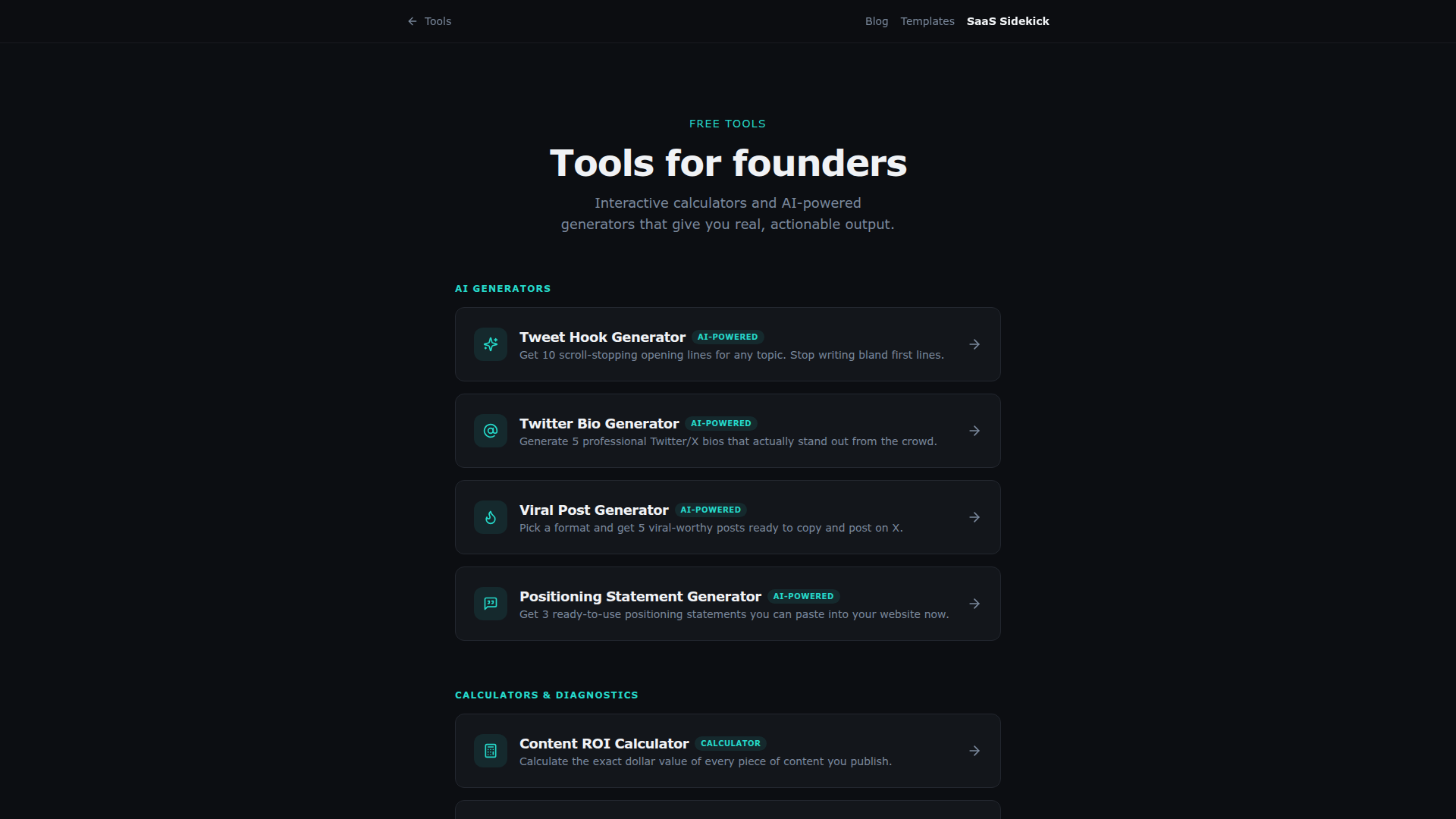
- Our own SEO tools: We built keyword density and meta tag analyzers to streamline this internally.
Key Takeaway: Prioritize keywords that match a real pain your SaaS solves. A handful of highly qualified visitors beats thousands of random ones.
Mapping Keywords to the Customer Journey
We categorized every keyword by where someone is in their journey:
- Awareness: "How to get users for my SaaS," "marketing for MVP"
- Consideration: "AI content generator for SaaS," "best social media scheduler for founders"
- Decision: "SaaS Sidekick vs. [Competitor]," "SaaS Sidekick pricing"
This mapping drove targeted content for each stage, guiding prospects toward our solution naturally.
Phase 4: Content Strategy. Becoming the Resource, Not the Pitch.
With keywords locked in, we needed content. Not generic content. We wanted to become THE resource for solo founders and indie hackers struggling with marketing. Our strategy wasn't about selling. It was about solving problems.
The "Help First" Approach
Every post, guide, and comparison had one goal: help the person reading it. No sales pitches sprinkled throughout. If they get real value and then discover our product fits, great. If not, at least they got something useful. That builds trust. And trust is what organic growth runs on.
Our content pillars:
- Blog Posts: Tactical, specific, like "5 social media tactics for lean SaaS teams" (see our blog)
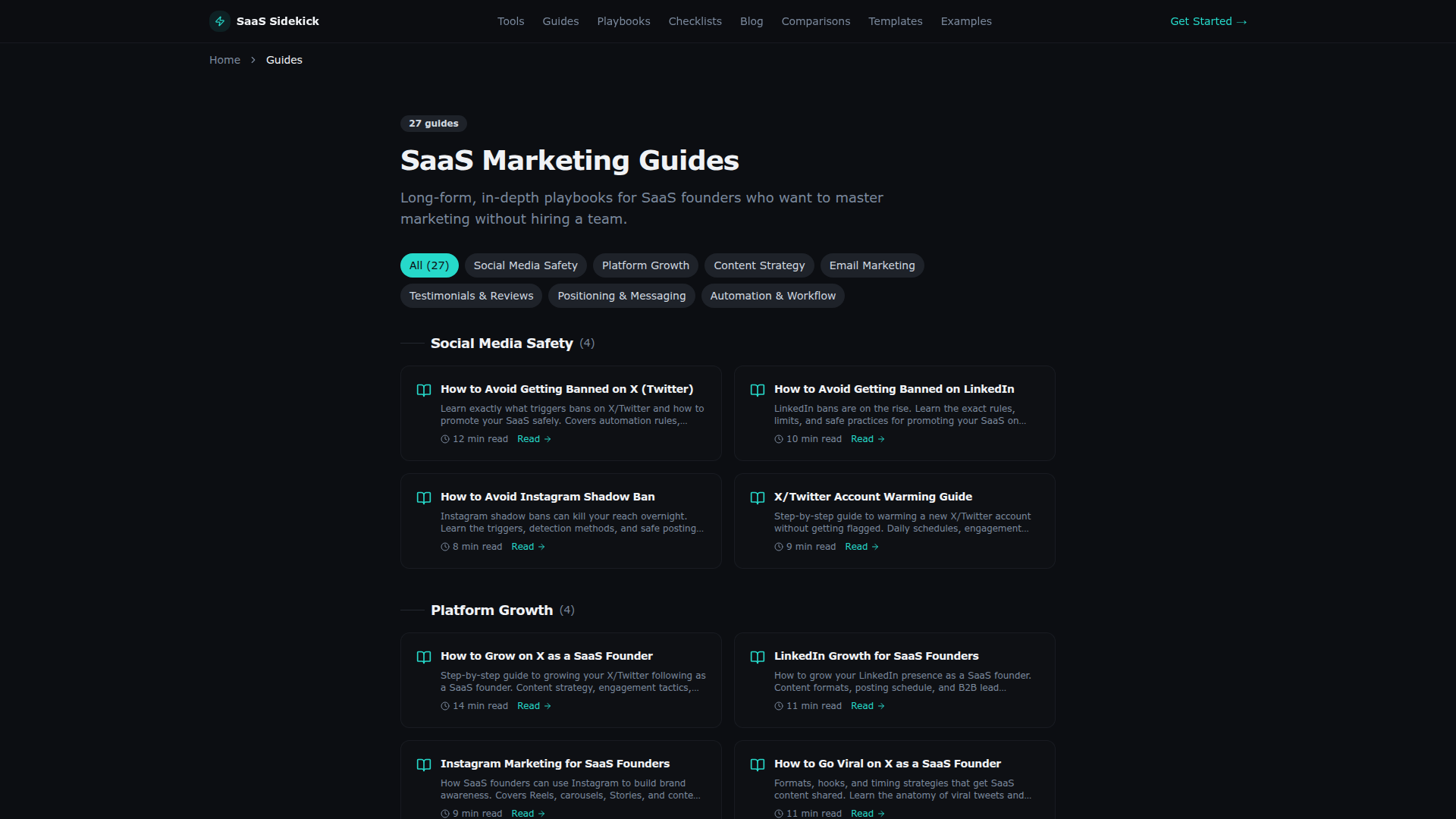
- Long-Form Guides: Deep dives like this one, with actionable playbooks (our guides section)
- Tools & Resources: Interactive calculators, a glossary, and comparison tables that provide direct utility
Pro Tip: Write for the human on the other side of the screen. Plain language. Break down complex topics. Make it actionable. Your audience is busy and wants solutions, not jargon.
The Content Hub Model
Instead of isolated blog posts, we started thinking in content hubs. A central pillar page (like this playbook) covering a broad topic, linking out to specific cluster pages. This signals to Google that you're an authority on the subject.
Phase 5: On-Page SEO. Making Sure Google Gets It.
Content is important, but without proper on-page optimization, even great content can get buried. This phase was about making sure search engines understand what each page is about.
The Elements That Move the Needle:
- Title Tags: Compelling, keyword-rich, under 60 characters. Arguably the most important single element.
- Meta Descriptions: Concise summaries that encourage clicks. We used our own meta tag analyzer to perfect these.
- Header Tags (H1, H2, H3): Logical content structure. H1 for the main topic, H2/H3 for subtopics.
- Keyword Placement: Natural integration of target keywords, especially in the first paragraph and headings.
- Image Optimization: Descriptive alt text and compressed files for faster loading.
- Internal Linking: Connecting relevant pages within our site. Spreads authority and keeps users engaged.
- URL Structure: Short, descriptive URLs with keywords.
Key Takeaway: On-page SEO is attention to detail, not rocket science. Every element should reinforce the page's topic and make it easy for both search engines and humans to understand.
Phase 6: Off-Page SEO. Building Real Authority.
This is where things get collaborative. Off-page SEO is primarily about backlinks: other reputable sites linking to yours. Think of them as votes of confidence.
Earn Links, Don't Buy Them
We never did spammy link building. Our approach: create content so valuable that other sites want to link to it. Takes longer, but it's the only approach that lasts.
How we earned links:
- Guest Posting: Writing for relevant SaaS and marketing blogs with natural links back.
- Resource Pages: Our glossary and tools became resources other sites referenced organically.
- Broken Link Building: Finding broken links on relevant sites and suggesting our content as a replacement.
- Community Engagement: Genuine participation in Indie Hackers, Reddit, Twitter. Helpful answers that sometimes led to organic mentions.
- Comprehensive Guides: Creating best-in-class content (like this playbook) that people naturally want to reference.
Pro Tip: Quality over quantity with backlinks, always. One link from a respected industry publication beats a hundred from random directories.
Phase 7: Brand Building in Your Niche
For SaaS, "Local SEO" isn't about Google Maps. It's about being recognized within your specific community.
- Niche Directories: Product Hunt, Capterra, G2, plus founder-specific directories.
- Community Presence: Active on Indie Hackers, Twitter, relevant Slack groups. Our brand became associated with helping early-stage founders.
- Brand Mentions: Even unlinked mentions of "SaaS Sidekick" contribute to brand recognition, which Google loosely ties to authority.
Phase 8: Data Analysis. Measure, Learn, Repeat.
SEO is never "done." It's a loop: analyze, adjust, improve. We spent serious time in Google Analytics and Search Console. These tools are your eyes and ears.
What We Tracked:
- Organic Traffic: How many visitors from search engines?
- Keyword Rankings: Moving up or down for our targets?
- Impressions vs. Clicks: Reveals issues with titles and meta descriptions.
- Bounce Rate: Are people leaving immediately? Content might not match expectations.
- Time on Page: Are visitors actually reading? Longer = more valuable.
- Conversions: Are organic visitors signing up? The metric that matters most.
We did regular content audits. Underperforming pages got refreshed or retired. If something wasn't working, we either made it significantly better or cut it.
Key Takeaway: Let data drive your strategy, not intuition. What worked six months ago might not work today. Be ready to iterate constantly.
Our Metrics Evolution
| Metric |
Early Focus (Phase 1-3) |
Ongoing Focus (Phase 4-9) |
| Organic Traffic |
Volume |
Quality & Conversion |
| Keyword Rankings |
Top 10 for anything |
Top 3 for high-intent, long-tail |
| Time on Page |
~1:30 min |
3:00+ min (long-form) |
| Bounce Rate |
Often >70% |
<50% |
| Conversions |
Too early to track |
Direct signup attribution |
Phase 9: Automation. Because Your Time Is Too Valuable for Manual Grind.
At some point, the manual work becomes unsustainable. As founders, time is the scarcest resource. This is exactly why we built SaaS Sidekick. We realized that most of the repetitive, brain-draining SEO work could be automated or significantly assisted by AI.
We Built What We Needed
We were already generating content ideas, drafting blog posts, optimizing meta descriptions, and scheduling social posts for our own SEO. It worked, but it was eating hours every week.
That's when it clicked: what if we could package our entire SEO workflow and offer it as an AI-powered co-pilot?
SaaS Sidekick helps you execute phases 3, 4, 5, and parts of 8 with way less effort:
- Keyword Research: AI-assisted identification of long-tail, high-intent keywords for your niche.
- Content Generation: From ideation to full blog posts, emails, and social updates. All SEO-optimized and written in your voice.
- On-Page Optimization: Auto-generated title tags, meta descriptions, and internal linking suggestions.
- Competitive Analysis: Identifying content gaps you can fill.
- Content Calendars: Structured execution plans so you never stare at a blank screen again.
Essentially, SaaS Sidekick gives you a marketing team in a box. Focus on building your product while organic growth runs in the background.
Key Takeaway: Use automation to multiply your marketing without multiplying your team or budget. Spend less time on repetitive tasks, more time on strategy and product.
The Mistakes We Made (So You Don't Have To)
We messed up plenty. Here are the biggest ones:
- Chasing generic keywords. Trying to rank for "marketing" when we should have targeted "marketing for indie SaaS founders." Tempting, but a dead end.
- Ignoring technical SEO. We published content before the site was properly optimized. Good content struggled to rank because of technical issues.
- Inconsistent publishing. Writing a few posts, getting discouraged, stopping. SEO is a marathon. Consistency beats sporadic effort every time.
- Being too salesy. Thinking every post needed a hard CTA. People want solutions first, not pitches. Earn trust, then convert.
- Skipping analytics. Publishing and moving on without checking results. That's just guessing in the dark.
- Keyword stuffing. Cramming keywords everywhere. Google spots it, readers hate it, rankings suffer. Our SEO tools help prevent this.
- Ignoring mobile. Assuming the desktop experience was enough. It never is.
Start Building Your Organic Growth Engine
You're a founder. You solve problems. Don't let marketing become a problem you can't crack.
This is the exact process we followed. It led us to build SaaS Sidekick, an AI marketing co-pilot we genuinely believe is the missing piece for founders who'd rather build than blog.
We built our organic growth machine. Now we've built the tools to help you build yours.
The blank screen doesn't have to be a wall. It can be a starting point. Your product deserves to be found.
Related Reading
FAQ
How long does SEO take for a new SaaS website?
Most SaaS websites start seeing measurable organic traffic within 3-6 months of consistent SEO effort. Quick wins like long-tail keywords and comparison pages can rank within weeks, while competitive head terms may take 6-12 months.
What is the most important SEO strategy for SaaS?
Building topical authority through content clusters is the single most impactful SEO strategy for SaaS. Create a pillar page for your core topic, then surround it with 10-20 supporting articles that interlink. This signals expertise to Google and captures traffic across the entire topic.
Should SaaS companies focus on SEO or paid ads?
Both have their place, but SEO provides compounding returns that paid ads cannot. Every dollar spent on SEO content continues generating traffic indefinitely, while paid ads stop the moment you pause spending. For bootstrapped SaaS founders, SEO is the better long-term investment.
How do I measure SEO success for my SaaS?
Track organic traffic growth, keyword rankings for target terms, click-through rates from search results, and most importantly, signups and conversions from organic traffic. Use Google Search Console for search data and your analytics tool for conversion tracking.
{{stat:91%|of web pages get zero organic traffic from Google (Ahrefs)}}
Related